
From Click City:
Roger looked up at the pigeons perched on the feed antenna. “Not again,” he said under his breath. He was convinced — even if he couldn’t actually hear the static — that bird droppings were interfering with the high-frequency microwaves and lowering his SNR. This was enough — almost — to back out of the deal on the Dolores Street house.
Roger was not the first to worry that pigeons create interference.
Arno Penzias and Robert Wilson of Bell Labs received the Nobel Prize in 1978 for discovering Cosmic Microwave Background Radiation (CMB) that provided evidence for the Big Bang.
While using a surplus communications antenna to map the Milky Way, Penzias and Wilson noticed noise that interfered with their measurements.
The Bell Labs test antenna (pictured) was 50 feet long, not including the small control building that moved with the antenna, quite a bit larger than Roger’s 18 inch dish. Roger would be excited to have the Holmdel horn on his roof but thinks the neighbors might object. Also, the 18-ton weight could also be a problem for his Victorian house.
The Bell Labs team sought to eliminate every possible source of interference, including pigeon nests. But every time they would clean off the pigeon droppings, the pigeons would come back to roost. After a long fight with the pigeons they were able to conclude that the noise was significant but after more than a year of experimentation still had no idea of the source.
Penzias was then referred to a talk and paper by P J E Peebles, a young Princeton astrophysicist who had predicted just the sort of noise that they had detected. He analyzed the characteristics of the early universe and calculated there would be detectable radio signals from 380,000 years after the big bang. Penzias called Robert Dicke, another Princeton physicist who coincidentally was building (but had not yet finished) a radio telescope to look for this radiation.
The Big Bang was controversial (even disreputable), plus Wilson believed the Steady State model, not the Big Bang. Penzias and Wilson’s paper described the static but studiously avoided any mention of the controversial Big Bang theory. Instead they let their Princeton colleagues go out on a limb (and also share in the credit) with the perilous interpretation that the static was “noise” leftover from the creation of the universe. After explaining the source of the unexpected noise Dicke commented to teammates Peebles, Roll and Wilkinson “Boys, we’ve been scooped.”
Note: the Penzias/Wilson paper was entitled “A Measurement of Excess Antenna Temperature at 4080 Mc/s,” a very bland title.
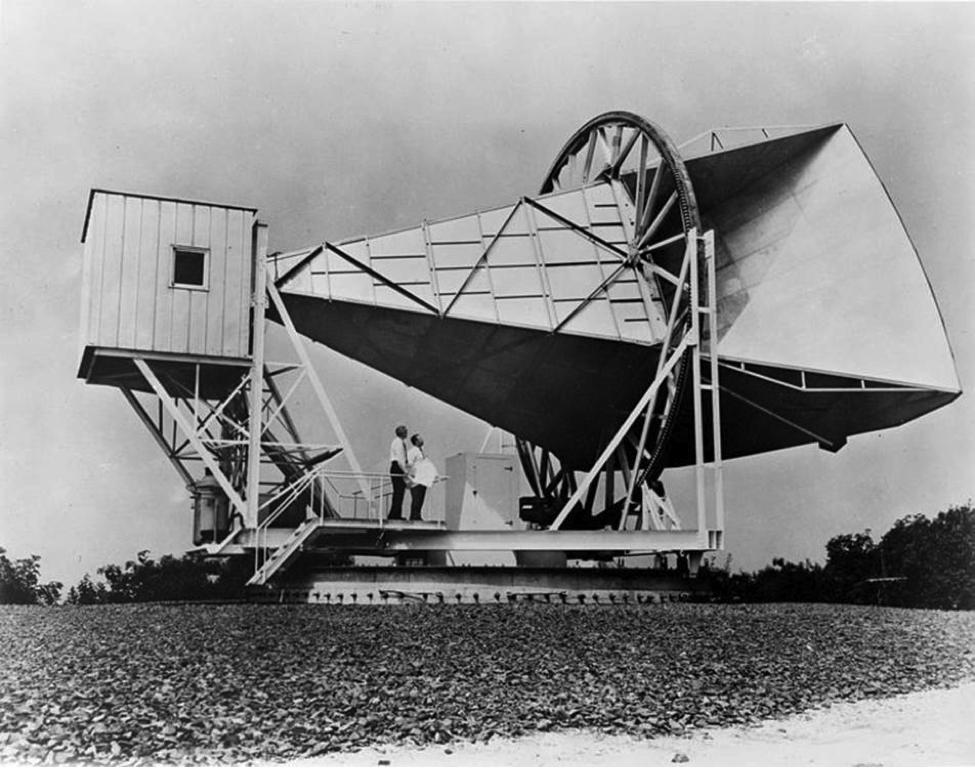
Roger’s dream antenna